 Crucis
Bible at a Glance · New Testament
Acts
Acts of the Apostles · 28 chapters · 6 min read
Scripture quotations from the Douay-Rheims Bible (Challoner revision)
A rushing wind. Tongues of fire. A small band of Apostles who suddenly cannot stop speaking about Jesus.
Acts is the Church's first chapter, full of prisons, storms and astonishing conversions, and the same Holy Spirit who drives it is still at work in her today.
The Book of Acts is the second volume of Saint Luke's great work, and it tells the story of how the Gospel, begun by Jesus in Israel, was carried by the Apostles through the power of the Holy Spirit from Jerusalem all the way to Rome.
The Birth of the Church
For forty days after His Resurrection, Jesus appeared to the Apostles and spoke to them about the Kingdom of God. Before He went up to heaven, He told them what their mission would be.
But you shall receive the power of the Holy Ghost coming upon you, and you shall be witnesses unto me in Jerusalem, and in all Judea, and Samaria, and even to the uttermost part of the earth.
Acts 1:8 Then a cloud took Him from their sight, and the Apostles went back to Jerusalem to pray together with Mary and the other disciples.
They chose Matthias by lot to take the place of Judas, so that the Twelve were complete again.
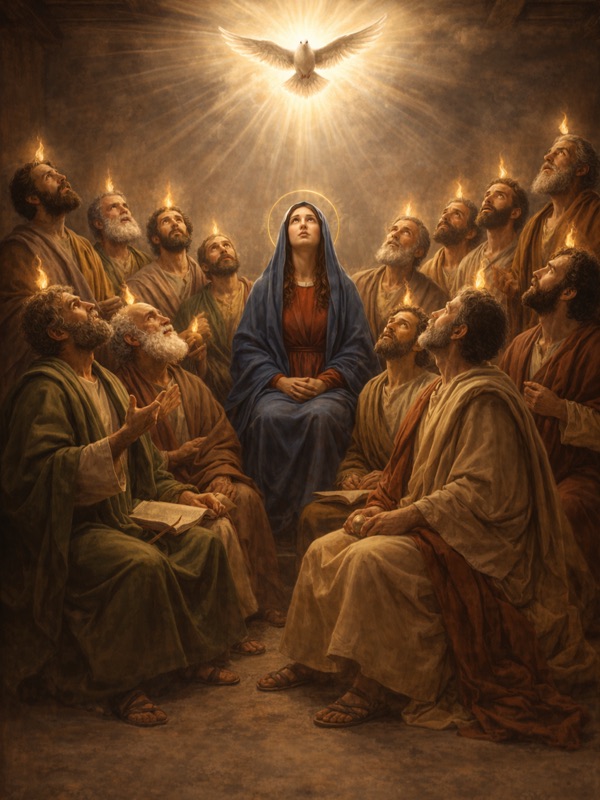
On the feast of Pentecost, fifty days after the Passover, the Holy Spirit came down upon them like a rushing wind and tongues of fire. They began to speak in many languages, and Jews from every nation heard them proclaim the wonders of God.
Peter stood up with the other eleven and preached Jesus crucified and risen. When the people asked what they should do, he answered: Do penance, and be baptized every one of you in the name of Jesus Christ, for the remission of your sins: and you shall receive the gift of the Holy Ghost.
Acts 2:38 About three thousand were baptized that day.
The first Christians listened to the teaching of the Apostles, broke bread together, prayed, and shared what they owned with those in need.
Witnesses in Jerusalem
Peter and John healed a man who had been lame from birth at the gate of the Temple, in the name of Jesus. When the rulers arrested them, Peter spoke without fear: Neither is there salvation in any other. For there is no other name under heaven given to men, whereby we must be saved.
Acts 4:12
The Apostles were warned, imprisoned and beaten, yet they never stopped preaching. Seven men were chosen to serve the poor, and one of them, Stephen, was stoned to death. He was the first martyr, and a young man named Saul stood by and approved.
A great persecution then scattered the believers through Judea and Samaria, and they carried the word wherever they went. Philip preached in Samaria, and Peter and John came down to pray that the new believers receive the Holy Spirit. Afterward Philip baptized an official of Ethiopia.
The Conversion of Saul
Saul set out for Damascus to arrest the Christians there. On the road a light from heaven struck him to the ground, and the voice of Jesus asked why he was persecuting Him. Saul was blind for three days, until a disciple named Ananias laid his hands on him. His sight returned, and he was baptized.
The Lord had told Ananias: Go thy way: for this man is to me a vessel of election, to carry my name before the Gentiles, and kings, and the children of Israel.
Acts 9:15
The Gentiles Welcomed
In Joppa, God showed Peter in a vision that he must not call unclean what God has made clean. He then went to Caesarea, to the house of Cornelius, a Roman centurion who feared God. While Peter was still speaking, the Holy Spirit fell upon the Gentiles there, and Peter baptized them.
In Antioch the disciples were called Christians for the first time. In Jerusalem, King Herod put the Apostle James to death and imprisoned Peter, but an angel freed him in the night.
The Journeys of Paul
The Church at Antioch sent out Barnabas and Saul, who was also called Paul, on the first missionary journey. They preached in Cyprus and in the cities of Asia Minor, and many Gentiles believed.
Then a question arose: must the Gentiles first keep the Law of Moses? Around the year fifty the Apostles and elders met in Jerusalem. Peter and James spoke, and under the guidance of the Holy Spirit they decided that the Gentiles were not bound to circumcision.
On his second journey Paul crossed into Europe. He preached at Philippi, Thessalonica and Athens, where he spoke to the philosophers on the hill of the Areopagus. In Corinth he remained a year and six months.
On his third journey Paul spent about three years in Ephesus, strengthening the Churches. At Miletus he gave a farewell to the elders, knowing that chains awaited him.
Arrest and Journey to Rome
Paul returned to Jerusalem, where a mob seized him in the Temple. The Romans took him into custody, and he was held at Caesarea for two years. At last, as a Roman citizen, he appealed to the Emperor.
He sailed for Rome under guard. A terrible storm broke the ship apart off the island of Malta, yet all on board were saved, as God had promised Paul.
In Rome Paul lived under guard for two whole years. He received all who came to him and preached the Kingdom of God openly and without hindrance. There the book ends.
The central message of Acts is that the risen Christ continues His work in the Church through the Holy Spirit. The Gospel is meant for all peoples, and it goes forth by the Apostles and their successors, with Peter at their head, so that every nation may be saved in Jesus Christ, the one Lord and Savior.
Takeaway
Acts does not really end. Paul sits under guard in Rome, welcoming everyone who comes, and the book simply stops.
The story was never meant to close there. It runs on through every baptism and every parish, all the way to you.
You may feel too ordinary for that, or too far gone. Saul once set out to arrest Christians, and God still chose him.
Ask the Holy Spirit this morning for one chance to speak of Jesus, and take it when it comes.