 Crucis
Bible at a Glance · Old Testament
Deuteronomy
The Pentateuch · 34 chapters · 5 min read
Scripture quotations from the Douay-Rheims Bible (Challoner revision)
One hundred and twenty years old, with a river he will never cross. Moses has one last sermon left, and he makes it count.
Deuteronomy holds his farewell, a call to love God with your whole heart, the very command Jesus named the greatest of all.
The Book of Deuteronomy is the fifth book of the Bible and tells how Moses, at the edge of the Promised Land, spoke to Israel for the last time and called the people to stay faithful to the Lord.
Moses Looks Back
Israel stood in the plains of Moab, east of the Jordan River. Forty years had passed since they left Egypt, and the generation that came out of slavery had almost all died in the desert.
Moses was now one hundred and twenty years old. He knew he would not cross the river, so he gathered the people to remind them of all that God had done.
He recalled how the Lord freed them from Egypt, led them to Mount Sinai, and gave them the Law. He recalled also their complaints and rebellions, and how their fear had kept the earlier generation out of the land.
The Law of the Covenant
Moses then repeated the Ten Commandments and explained them. The name Deuteronomy means second law, because the book restates the Law for a new generation about to enter the land.
At the heart of his teaching stands the great command of Israel's faith: Hear, O Israel: the Lord our God is one Lord. Thou shalt love the Lord thy God with thy whole heart, and with thy whole soul, and with thy whole strength.
Deuteronomy 6:4-5
Moses told parents to teach these words to their children at home and on the road, morning and evening. Faith was to be handed down from one generation to the next.
He warned the people not to forget God once they were rich and settled in good land. He reminded them that He had fed them in the desert and humbled them in order to teach them.
Moses spoke with the love of a father. He did not only give orders; he explained why the commands were good, saying that they were given for the life and happiness of the people.
Laws for Life in the Land
The book then sets out many laws for the life of the nation. There is one place of worship, where the people bring their offerings and feast before the Lord. Idols and false prophets are forbidden.
The laws protect the weak. The poor, the widow, the orphan, the foreigner and the Levite are to be cared for, debts are to be released every seventh year, and judges must not take bribes.
The book also teaches about kings, priests and prophets. Moses promised: The Lord thy God will raise up to thee a prophet of thy nation and of thy brethren like unto me: him thou shalt hear.
Deuteronomy 18:15
Blessings and Curses
Moses told Israel to renew the covenant when they entered the land. Blessings were to be proclaimed from Mount Gerizim and curses from Mount Ebal.
Obedience would bring peace, harvest and victory. Turning away from God would bring hunger, defeat and exile from the land.
Moses knew his people's weakness and foretold that they would fail. Yet he also promised that if they returned to the Lord with all their heart, He would gather them again and have mercy.
Then he made his final appeal: I call heaven and earth to witness this day, that I have set before you life and death, blessing and cursing. Choose therefore life, that both thou and thy seed may live.
Deuteronomy 30:19
The Death of Moses
Moses named Joshua as his successor and gave the written Law to the priests, to be read aloud to all Israel every seventh year. He taught the people a song that would remain a witness to them, and he blessed each of the tribes before he died.
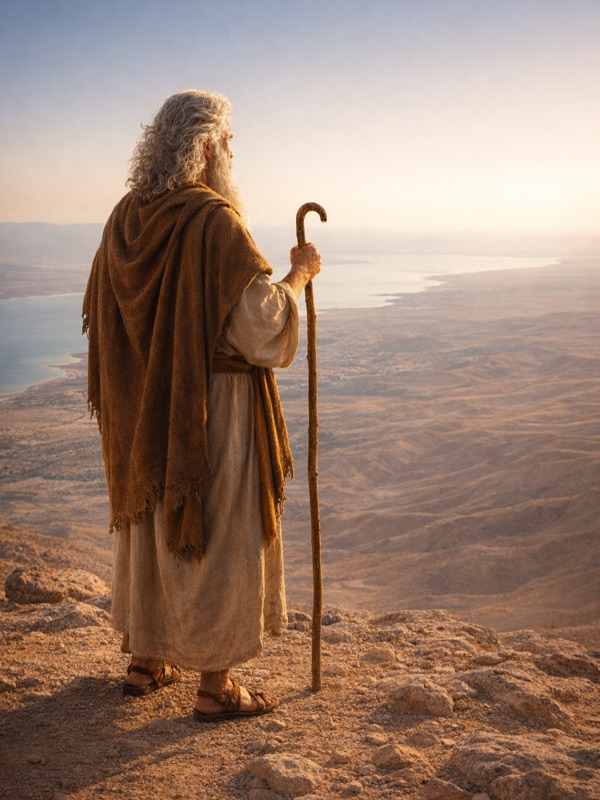
Then Moses climbed Mount Nebo. The Lord showed him the whole land from the mountain top, though he was not to enter it.
There Moses died, one hundred and twenty years old, and the Lord buried him. The book says that no prophet since has arisen in Israel like Moses, whom the Lord knew face to face.
The central message of Deuteronomy is that God loves His people and calls them to answer with wholehearted love, shown in obedience, justice and mercy. Jesus Christ declared the command to love God with all one's heart to be the greatest of all, and He turned back the tempter with words from this book. The prophet like Moses is fulfilled in Christ, who speaks the Father's words and leads His people not into an earthly land but into eternal life.
Takeaway
From the top of Mount Nebo, Moses sees the whole land spread out before him. He dies there, and the Lord Himself buries him.
He never set foot in it. Many of us carry unfinished hopes and wonder whether a life still counts.
Moses' life counted. God knew him face to face.
He set life and death before the people and urged them to choose life. Choose it today: pray the Our Father slowly, and mean every word.