 Crucis
Blog · July 23, 2026
The Biblical and Historical Case for One True Church
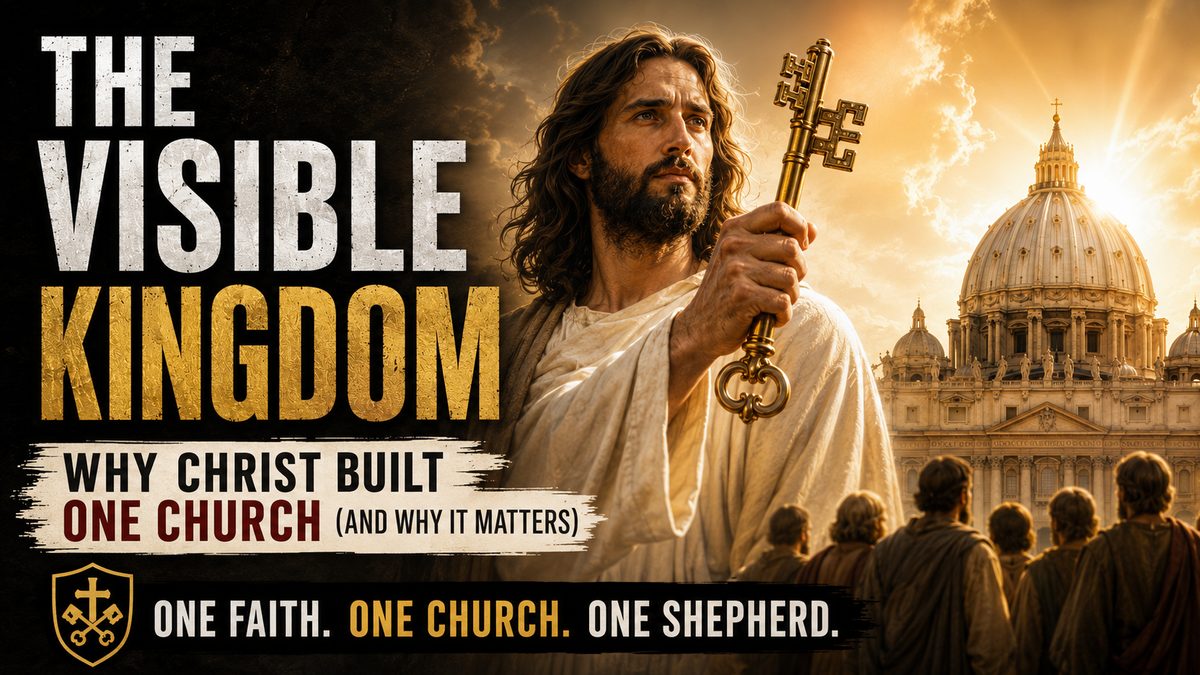
There is a persistent, comforting myth circulating in modern Christian culture. You hear it in small groups, read it on social media, and see it reflected in non-denominational chapels across the world:
"The Church isn't a building or an institution—it's an invisible community of all true believers everywhere."
It sounds appealing on the surface because it promises harmony without sacrifice. It tells us that doctrine doesn't divide us, that authority doesn't matter, and that every individual can construct their own altar to God.
However, when we turn the pages of Sacred Scripture and look through the eyes of the earliest Christians, that myth dissolves. Jesus Christ did not leave behind a set of abstract ideas and a "do-it-yourself" faith. He did something far more radical and concrete: He founded a single, visible, organized Church—and He gave it His own authority.
The Prayer for Visible Unity
On the night before He was tortured and crucified, Our Lord prayed for His disciples in the Upper Room. His prayer was not for worldly success, military conquest, or personal safety. His supreme petition to the Father was for unity:
"I do not pray for these only, but also for those who hold faith in me through their word, that they may all be one; even as thou, Father, art in me, and I in thee, that they also may be in us, so that the world may believe that thou hast sent me." — John 17:20–21
Notice why Jesus prayed for this unity: "so that the world may believe."
An invisible, spiritual-only unity cannot fulfill this mission. The pagan world cannot see "invisible harmony" among tens of thousands of split denominations, each teaching conflicting doctrines on baptism, salvation, and the Eucharist. When Christians disagree on the very definition of the Gospel, the world looks on and concludes that truth cannot be found among us.
Christ prayed for a unity so real, so tangible, and so visible that it would serve as an undeniable sign of His divine mission.
The Rock, the Steward, and the Keys
Christ did not leave this unity to chance or human goodwill. He knew human nature. He knew that without a clear, God-given earthly shepherd, sheep naturally scatter.
In the region of Caesarea Philippi, Jesus asked His Apostles, "Who do you say that I am?" Simon answered by grace: "You are the Christ, the Son of the living God."
Continue reading in the app — free.