 Crucis
Bible at a Glance · Old Testament
1 Chronicles
Historical books · 29 chapters · 4 min read
Scripture quotations from the Douay-Rheims Bible (Challoner revision)
It begins with Adam and a long list of names. To a people who had lost their kingdom, every name said: you still belong to God.
1 Chronicles retells David's story with its eyes on worship, and points to the Son of David whose kingdom lasts forever.
The Book of 1 Chronicles is a history of God's people, written for Israel after its return from exile, and it tells the story of how God chose David and his house to lead His people and to prepare a place of worship for His name.
The Long List of Names
The book opens with names. Beginning with Adam, it traces the families of mankind and then of Israel, through Abraham, Isaac and Jacob, down to the tribes and the royal line of Judah.
These lists remind a people who had lost their kingdom that they had not lost their identity. God had walked with their fathers from the very beginning, and they still belonged to Him.
The Fall of Saul
The story proper begins with the death of Saul, Israel's first king. He fell in battle against the Philistines on Mount Gilboa, and the book says he died because he was unfaithful to the Lord.
David Becomes King
After Saul, all the tribes gathered and anointed David king. He took the stronghold of Jerusalem from the Jebusites and made it his city, and it was called the city of David.
The Ark and the Promise
David brought the Ark of the Covenant to Jerusalem with music, song and great rejoicing. The Ark was the sign of God's presence among His people, and David wanted it at the centre of the nation's life.
On that day David appointed Levites to sing before the Ark. Their hymn of thanks included the words: Give ye glory to the Lord, for he is good: for his mercy endureth for ever.
1 Chronicles 16:34
Then David wished to build a house for God, since he himself lived in a house of cedar. Through the prophet Nathan, God answered that David would not build it. Instead, God would build a house for David, and a son of his would reign, with a kingdom that God would establish for ever.
David's Wars and Failure
David won victories over the neighbouring nations, and Israel grew secure. But the book also records his failure. David ordered a census of the people, trusting in numbers rather than in God, and a plague fell on Israel.
David repented, and God stopped the plague at the threshing floor of Ornan the Jebusite. David bought the place and built an altar there. That ground became the site of the Temple.
Preparing the Temple
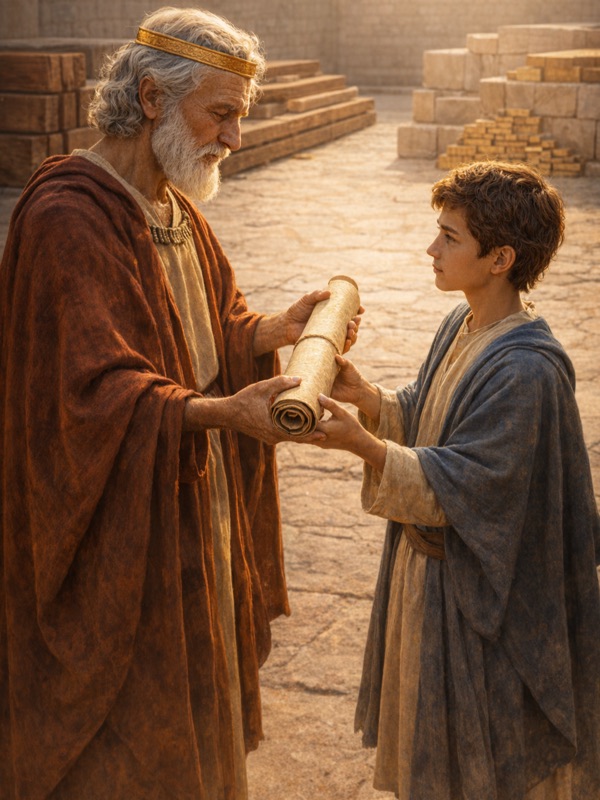
David was not allowed to build, but he gathered gold, silver, bronze, iron, timber and stone in great quantity. He gave Solomon his son the plans, and charged him to build the house for the Lord.
The Last Days of David
At the end of his life David called together all the leaders of Israel. He presented Solomon as the one God had chosen, and the people gave generously for the Temple.
Then David blessed the Lord before the whole assembly and prayed: Thine, O Lord, is magnificence, and power, and glory, and victory: and to thee is praise: for all that is in heaven and in earth is thine: thine is the kingdom, O Lord.
1 Chronicles 29:11
David died after reigning forty years, seven in Hebron and thirty-three in Jerusalem. He lived about one thousand years before Christ, and Solomon took the throne after him.
The central message of 1 Chronicles is that God is faithful to His promises and works through the line of David to bring His people to true worship. The promise made through Nathan, of a son whose kingdom would last for ever, finds its fulfilment in Jesus Christ, born of the house of David. He is the true King, and the true Temple, in whom God dwells among His people and in whom the Church offers praise to the Father.
Takeaway
At the end of his life, David stands before the whole assembly and blesses God, to whom all things in heaven and on earth belong.
He never built the Temple he wished for. He gathered gold, timber and stone, handed over the plans, and let his son finish.
Some of our work, too, will be completed by others. That is not failure; it is faith.
Do one hidden good today for someone who will come after you, and offer it to God.