 Crucis
Bible at a Glance · Old Testament
2 Chronicles
Historical books · 36 chapters · 4 min read
Scripture quotations from the Douay-Rheims Bible (Challoner revision)
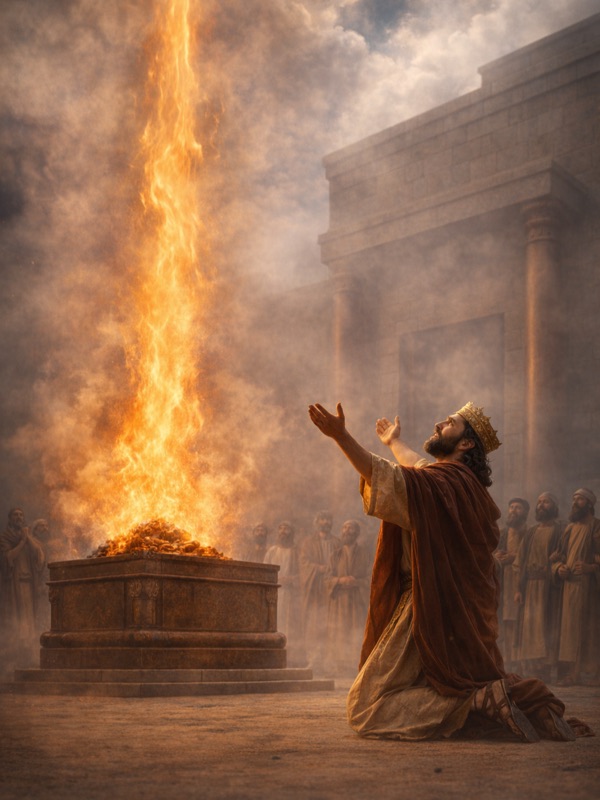
Fire falls from heaven onto Solomon's altar. Centuries later, fire of another kind leaves the same Temple in ashes.
2 Chronicles follows the kings of Judah through reform and ruin, and holds out God's promise to forgive and heal a people who turn back to Him.
The Book of 2 Chronicles is a history of the kings of Judah, from Solomon to the exile in Babylon, and tells the story of how God's people prospered when they worshipped Him in His Temple and fell when they abandoned Him.
Solomon and the Temple
Solomon, the son of David, became king of Israel. At Gibeon he offered sacrifice, and God asked what He should give him. Solomon asked for wisdom to judge the people, and God gave him wisdom, along with great riches.
Solomon then built the Temple in Jerusalem on Mount Moriah, as his father had desired. The work took seven years, and the house was covered with gold and filled with beautiful furnishings.
When the Ark of the Covenant was brought into the Temple, a cloud filled the house, for the glory of the Lord was there. Solomon knelt and prayed before all the people, and fire came down from heaven upon the sacrifice.
Later God appeared to Solomon by night and promised mercy to a repentant people: then will I hear from heaven, and will forgive their sins, and will heal their land.
2 Chronicles 7:14
Kings came from far away to hear his wisdom, and the Queen of Sheba came as well. Solomon reigned forty years.
The Divided Kingdom
After Solomon died, his son Rehoboam answered the people harshly when they asked for lighter burdens. Ten tribes rebelled, and the kingdom split around nine hundred and thirty years before Christ. Judah, with Jerusalem and the Temple, stayed under the descendants of David, while the northern tribes followed their own kings.
From this point the book follows mostly the kings of Judah. It records that many of them did evil, and that the people turned again and again to idols.
Kings Who Returned to God
King Asa removed foreign altars and sought the Lord. Jehoshaphat sent teachers through the cities with the book of the Law, and when enemies surrounded Judah, he called the people to prayer and God gave them victory.
The wicked queen Athaliah seized the throne, but the wife of the priest Jehoiada hid the child Joash, and Jehoiada crowned him at seven years old. Joash repaired the Temple, yet after Jehoiada died he went astray.
Hezekiah opened the Temple doors again, cleansed the house, and kept a great Passover in Jerusalem. When the Assyrian king Sennacherib threatened the city, Hezekiah and the prophet Isaiah cried to heaven, and the Lord saved Jerusalem.
Manasseh, Hezekiah's son, was twelve when he began to reign and ruled fifty-five years. He set up idols even in the Temple. Taken in chains to Babylon, he humbled himself, and God brought him back to Jerusalem.
Josiah became king at eight years old. In his eighteenth year, while the Temple was being repaired, the book of the Law was found. He read it to the people, and they renewed the covenant. He was killed in battle around six hundred and nine years before Christ.
The Fall of Jerusalem
After Josiah, the last kings mocked God's messengers. The Lord sent prophets again and again, because He had compassion on His people, but they scorned His words until there was no remedy.
Around five hundred and eighty-seven years before Christ, Nebuchadnezzar of Babylon burned the Temple, broke down the walls of Jerusalem, and carried the people away to Babylon. The land lay desolate for seventy years.
The book ends with hope. Cyrus, king of Persia, declared that God hath charged me to build him a house in Jerusalem,
2 Chronicles 36:23 and he let the people go home.
The central message of 2 Chronicles is that God keeps His promise to David and remains faithful even when His people are not. The Temple, the true king and the mercy offered to the repentant all point to Christ, the Son of David, who is the true Temple, in whom God dwells among men, and whose kingdom will never end. In Him the exile of sin is finally over, and the people of God are brought home.
Takeaway
The last word belongs to Cyrus, a pagan king, sending the exiles home to rebuild. The book does not end in ashes.
Even Manasseh, who set up idols in the Temple itself, humbled himself in chains, and God brought him back.
No one has fallen too far for that kind of mercy, and that includes you.
If someone you love seems lost to God, do not give up on them. Pray a Rosary for them this week.