 Crucis
Bible at a Glance · Old Testament
Ecclesiastes
Wisdom books · 12 chapters · 4 min read
Scripture quotations from the Douay-Rheims Bible (Challoner revision)
Wealth, pleasure, wisdom, great works. He tried them all. A breath, he says. All of it.
Ecclesiastes stares honestly at work, joy and death, and its restless search readies the heart for the answer only Christ, risen from the dead, can give.
The Book of Ecclesiastes is a book of wisdom, and it teaches what truly lasts in a life that passes as quickly as a breath.
The Vanity of All Things
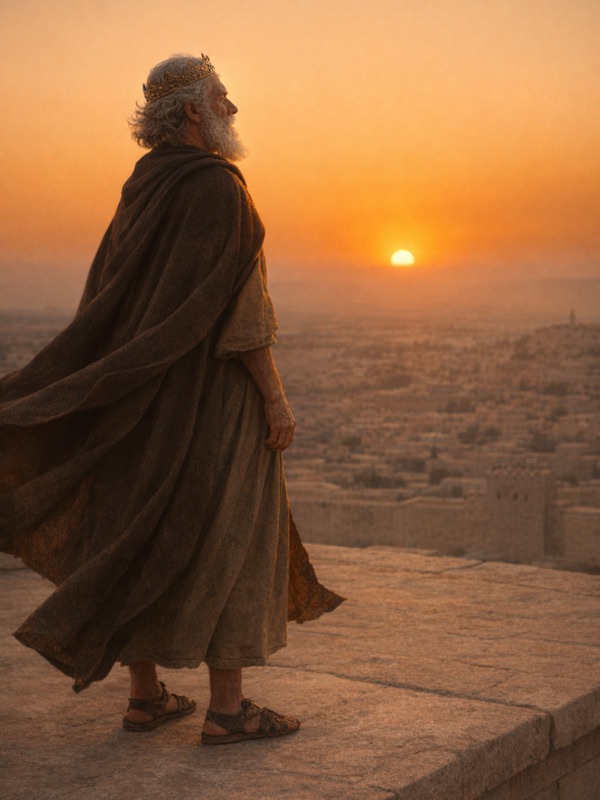
The book is spoken by a teacher who calls himself the son of David, king in Jerusalem. He begins with a cry: Vanity of vanities, said Ecclesiastes: vanity of vanities, and all is vanity.
Ecclesiastes 1:2
By vanity he means what is like a breath: it passes and cannot be held. He looks at the sun rising and setting, the wind turning, and the rivers running to the sea, and he sees that generations come and go while the earth remains.
The Search for Meaning
The teacher then tells how he searched for the meaning of life. He gave himself to wisdom, and then to pleasure, laughter and wine.
He built houses, planted vineyards and gardens, gathered silver and gold, and owned servants and flocks. Yet when he looked at all his works, he found no lasting profit under the sun.
He saw that the wise man and the fool both die, and that a man's labor is left to someone who comes after him. This troubled him deeply.
A Time for Everything
Yet the teacher does not end in despair. He teaches that God governs every moment of life: All things have their season, and in their times all things pass under heaven.
Ecclesiastes 3:1
There is a time to be born and a time to die, a time to weep and a time to laugh, a time to be silent and a time to speak. Man cannot grasp the whole work of God from beginning to end, but he can receive each day as a gift.
Life Under the Sun
The teacher sees injustice in the world: the oppressed have no comforter, and the wicked are honored in the place of judgment. Yet he declares that God will judge both the just and the wicked.
He warns that riches never satisfy and that words spoken hastily before God are foolish. He praises friendship, saying that two are better than one, and he advises simple joy in food, in work, and in the wife a man loves, as gifts from God's hand.
Remember Your Creator
Near the end he speaks to the young. He tells them to remember their Creator before old age comes, when strength fails and the eyes grow dim, and the body returns to dust while the spirit returns to God who gave it.
The book closes as it began, with the word vanity, but now it adds its conclusion: Fear God, and keep His commandments: for this is all man.
Ecclesiastes 12:13
The central message of Ecclesiastes is that nothing in this world can satisfy the human heart by itself, and that only God gives lasting meaning. The book looks honestly at death and so prepares the way for the Gospel, where Christ rose from the dead and gave the answer the teacher could only long for. In Him, our labor and our joys are not in vain, for He promises a life that does not pass away.
Takeaway
Near its end, Ecclesiastes turns to the young: remember your Creator before strength fails and the eyes grow dim.
It is possible to fill a life with busy things and still feel empty. Many of us know that quiet ache at the close of a full day.
The teacher's honesty is a gift. Nothing under the sun can fill the heart, because it was made for God.
Before this day ends, name one gift it brought you and thank Him for it.