 Crucis
Bible at a Glance · Old Testament
Esther
Historical books · 16 chapters · 3 min read
Scripture quotations from the Douay-Rheims Bible (Challoner revision)
One sleepless night changes everything. A king asks for the records to be read, and a plot to wipe out a whole people begins to unravel.
Esther reveals a God whose hand stays hidden but never idle, and a young queen who must decide whether to risk her life.
The Book of Esther is a short historical book of the Old Testament and tells the story of how God saved His people from destruction in Persia through a young Jewish woman who became queen.
The Queen Is Chosen
The story begins at the court of King Ahasuerus, who ruled one hundred twenty-seven provinces from India to Ethiopia. After Queen Vashti refused to obey his command, she was removed.
Esther, an orphan of the Jewish exiles, was raised by her kinsman Mordecai. Chosen from many young women, she was made queen in the seventh year of the king's reign, and she kept her people secret as Mordecai had told her.
Haman's Plot
The king then raised Haman to the highest place among his princes. Mordecai would not bow to him, and Haman, in fury, resolved to destroy all the Jews in the kingdom.
Haman cast lots to choose the day, and the king sealed a decree ordering that on one day, the thirteenth of the month of Adar, the Jews be killed.
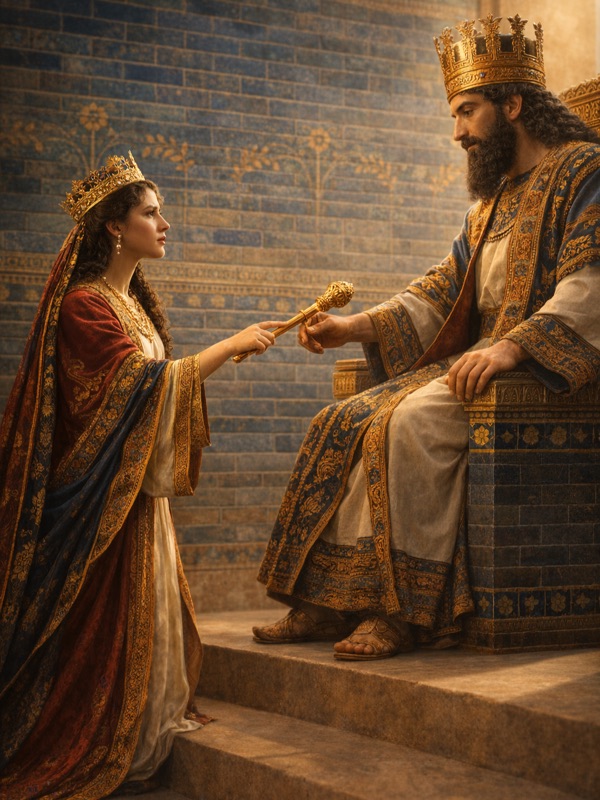
Mordecai mourned in sackcloth and urged Esther to go to the king. To enter unsummoned meant risking death. Mordecai answered her fear: Who knoweth whether thou art not therefore come to the kingdom, that thou mightest be ready in such a time as this?
Esther 4:14
Esther asked the Jews of Susa to fast for three days, and she prayed to the Lord God of Israel for help.
The Turning Point
Esther went to the king, and he received her kindly. She invited him and Haman to a banquet, and then to a second.
That night the king could not sleep and had the records read to him. He learned that Mordecai had once saved his life and had never been rewarded, and he ordered Haman himself to lead Mordecai in honor through the city.
At the second banquet Esther revealed that she was a Jew and that Haman plotted to destroy her people. The king, angered, had Haman hanged on the gallows Haman had prepared for Mordecai.
The Feast of Purim
Because a royal decree could not be revoked, the king allowed the Jews to defend themselves on the appointed day. They overcame their enemies, and Mordecai was raised to high rank.
The Jews kept those days as a yearly feast called Purim, in remembrance of the reversal of their sorrow into joy.
The central message of Esther is that God watches over His people even when His hand is hidden, and that He rescues them through the courage of the humble. The book prepares for Christ, who was born of this same people and who delivered mankind from death; and the Church sees in Esther, who risked herself to plead for her people, a figure of Mary, who intercedes for us.
Takeaway
Purim became a yearly feast to remember a day set for slaughter that turned into a day of joy.
Mordecai asked Esther whether she had come to the throne for just such a time. She was afraid, and after three days of fasting she went anyway.
You are where you are for a reason, even when God feels far away.
This week, speak up for someone who has no voice, and ask Mary to intercede for them.