 Crucis
Bible at a Glance · Old Testament
Judith
Historical books · 16 chapters · 4 min read
Scripture quotations from the Douay-Rheims Bible (Challoner revision)
Five days. That is how long Bethulia's leaders gave God before they would surrender. A widow thought that was no way to pray.
Judith tells how God used one praying woman to topple a mighty army, and the Church sees in her a figure of Mary.
The Book of Judith is a story from the Old Testament and tells the story of how a faithful widow saved her people from a mighty army when all human hope seemed lost.
The Threat to Israel
Nebuchadnezzar, who ruled the Assyrians from Nineveh, demanded that all the nations of the west submit to him. Many refused, and he sent his general Holofernes with a vast army to punish them.
Nation after nation fell, and the people of Israel became afraid. They prayed, fasted and prepared to defend the hill towns that guarded the road to Jerusalem.
Holofernes asked about this people. Achior, an Ammonite leader, warned that Israel could be beaten only if it sinned against its God, and Holofernes mocked him.
The Siege of Bethulia
The army surrounded the town of Bethulia and cut off its water. As the siege went on, the people were dying of thirst and begged their leaders to surrender. Their leader Uzziah asked them to wait five more days.
The Widow Judith
Then Judith came forward. She was a beautiful widow who had lived in prayer and fasting since her husband died, and she was respected for her devotion.
She rebuked the leaders for putting God to the test, and she told them she would act. She prayed for strength, then dressed in her finest clothes and went out with her maid to the enemy camp.
Judith and Holofernes
The guards brought her to Holofernes. She told him she would show him a way to take the hill country, and he was pleased and welcomed her.
She stayed in the camp for three days, going out each night to pray. On the fourth day Holofernes held a banquet, hoping to win her, and drank far too much wine.
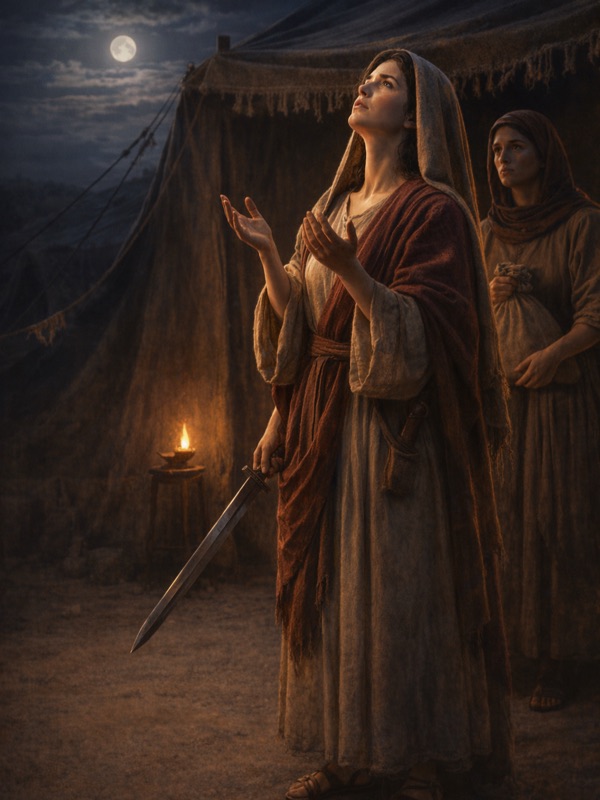
When the servants left, Judith was alone with him as he lay senseless. She prayed for strength, and with two strokes of his own sword she cut off his head. She and her maid carried it out in their food bag and returned to Bethulia.
The Victory
On her return Judith showed the head to the people, who gave thanks to God. Uzziah said to her: Blessed art thou, O daughter, by the Lord the most high God, above all women upon the earth.
Judith 13:23 Achior, seeing the head, believed in the God of Israel and was received into His people.
At daybreak the Israelites attacked the camp. The Assyrians found their general dead, panicked and fled, and Israel pursued them and took great spoil.
The high priest came from Jerusalem to bless Judith, and the people cried out to her: Thou art the glory of Jerusalem, thou art the joy of Israel, thou art the honour of our people.
Judith 15:10
Judith sang a hymn of praise to God, who defeats the mighty by the hand of a woman. She lived to a great age, and all Israel mourned her when she died.
The central message of Judith is that God protects those who trust in Him, and that He often uses the humble and the weak to overthrow the proud. In Judith the Church sees a figure of Mary, blessed among women, whose Son crushes the power of evil, and in Christ the victory of God over every enemy is complete.
Takeaway
Judith's story closes with her hymn of praise, a long life and all Israel mourning her death.
Before she acted, she prayed. In the enemy camp, she went out every night to pray. Before the final stroke, she prayed again.
You may face something far bigger than you. Courage begins on your knees.
Before your hardest task today, stop for one minute and ask God for strength, as Judith did.