 Crucis
Bible at a Glance · Old Testament
Ezekiel
The Prophets · 48 chapters · 6 min read
Scripture quotations from the Douay-Rheims Bible (Challoner revision)
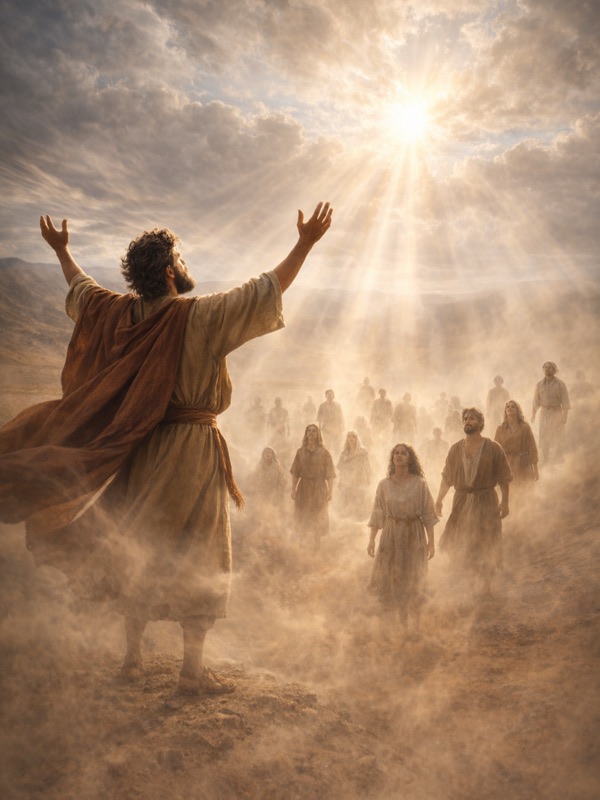
Can dry bones live? Ezekiel stood in a valley full of them and watched them rise.
His visions speak to exiles who had lost everything, and God promises them a new heart, His own Spirit and a river of life, all fulfilled in Christ.
The Book of Ezekiel is a prophecy and tells the story of how God spoke to His people in exile in Babylon, warned them that Jerusalem would fall, and then promised to give them a new heart and bring them home.
The Call of Ezekiel
Ezekiel was a priest of Jerusalem. Around five hundred ninety-seven years before Christ, Babylon carried him away with thousands of other people of Judah to a land beside the river Chebar.
There, in the fifth year of the exile, the heavens opened and he saw the glory of God. He saw a great storm cloud, living creatures with four faces, wheels full of eyes, and high above them a throne with the likeness of a man seated upon it.
God called him son of man and sent him to a rebellious people who would not want to listen. He gave him a scroll to eat, and it was sweet as honey in his mouth. God made him a watchman for the house of Israel, to warn them of danger whether they listened or not.
Judgment on Jerusalem
Ezekiel then spoke through strange actions. He lay on his side for many days, drew a siege of the city on a brick, and cut off his hair, all as signs of what would soon happen to Jerusalem.
God showed him the reason. In a vision Ezekiel was carried to the Temple, and there he saw idols and shameful worship in the very house of God. Then the glory of the Lord rose from the Temple and left the city.
Some in Israel said that the prophet spoke of times far away. God answered that His word would be fulfilled without delay. About five hundred eighty-seven years before Christ, Babylon destroyed Jerusalem and burned the Temple, exactly as Ezekiel had said.
Ezekiel also taught that each person answers for his own sins, and that God is just in all His ways.
Judgment on the Nations
Ezekiel spoke against the nations around Israel, among them Ammon, Moab, Edom, Tyre, Sidon and Egypt. Their pride and cruelty would not go unanswered, for the Lord is ruler of the whole earth, and no king can stand against Him.
Hope for the Exiles
When word came that Jerusalem had fallen, Ezekiel's message changed from warning to comfort. God made him a watchman again, and told him to say: As I live, saith the Lord God, I desire not the death of the wicked, but that the wicked turn from his way, and live.
Ezekiel 33:11
He condemned the shepherds of Israel who fed themselves and let the flock be scattered. God promised that He Himself would seek out His sheep, gather them, and set over them one shepherd, His servant David.
God also promised to renew His people from within. He said: And I will give you a new heart, and put a new spirit within you: and I will take away the stony heart out of your flesh, and will give you a heart of flesh.
Ezekiel 36:26 He would gather them from the nations, cleanse them with clean water, and place His Spirit among them.
Then Ezekiel was set down in a valley full of dry bones. At God's word the bones came together, flesh covered them, and breath entered them, and they stood up as a great army. The bones were the whole house of Israel, and God promised to open their graves and bring them back to their land.
He also joined two sticks into one, a sign that Judah and Israel would again be one people under one king. God would make with them a covenant of peace, and His dwelling would be with them forever.
After this Ezekiel foretold a last great attack on God's people by Gog, a ruler from the land of Magog. God would overthrow him, and all the nations would know that the Lord is holy.
The New Temple
In the twenty-fifth year of the exile, Ezekiel was carried in vision to a very high mountain. There a man with a measuring reed showed him a new Temple, measured gate by gate and court by court.
The glory of the Lord, which had left the old Temple, came back through the gate that faces east and filled the house.
Then Ezekiel saw water flowing from the threshold of the Temple. It grew from a small stream into a river too deep to cross, and it healed the salt waters it entered. On its banks grew trees whose fruit was food and whose leaves were for healing.
The book ends with the land divided among the tribes and a city at its center. God declared that the name of the city from that day would be The Lord is there.
Ezekiel 48:35
The central message of Ezekiel is that God is holy and just, yet He never abandons His people: He judges sin in order to heal, and He gives a new heart and His own Spirit. The Church sees this fulfilled in Jesus Christ, the Good Shepherd who lays down His life for the sheep, and whose body is the true Temple. From His pierced side came water, and the Church sees in Ezekiel's river the Baptism and the Spirit given through Him. The city where the Lord is present points to the heavenly Jerusalem, where God will dwell with His people forever.
Takeaway
Ezekiel ends with a city whose new name says everything: the Lord is there.
On hard days, that valley of dry bones can look like your own life: worn out, hollow, past any hope of change.
But God breathes life into what looked finished. He takes away hearts of stone and gives hearts of flesh.
As you enter a church this week, bless yourself with holy water and remember your Baptism, the river that first gave you life.