 Crucis
Bible at a Glance · New Testament
Hebrews
Letters of Saint Paul · 13 chapters · 5 min read
Scripture quotations from the Douay-Rheims Bible (Challoner revision)
Temple. Priesthood. Sacrifice. Hebrews takes everything Israel held holy and shows where it was always pointing.
To weary Christians tempted to turn back, it presents Jesus as the one High Priest, who entered heaven with His own Blood and offered Himself once for all.
The Book of Hebrews is a letter, written like a sermon, to Christians of Jewish background, and it teaches that Jesus Christ is greater than every person and every gift of the Old Covenant, because He is the Son of God and the one perfect Priest and Sacrifice.
The Son of God
The letter begins with no greeting. It opens by saying that God, who at sundry times and in divers manners, spoke in times past to the fathers by the prophets
Hebrews 1:1 has now spoken in a final way through His Son. The Son is the radiance of God's glory, and through Him the world was made.
The writer shows that the Son is greater than the angels. The angels serve God, but the Son sits at His right hand and is called God. The Son also became truly man, shared our flesh and blood, and tasted death for all.
The writer then compares Christ with Moses and with Joshua. Moses was faithful as a servant in God's house, but Christ is faithful as the Son over the house. The people who followed Moses out of Egypt wandered forty years in the desert and failed to enter the promised rest, and the letter warns that a true rest of God still waits for His people.
The Great High Priest
The heart of the letter is the priesthood of Christ. Every high priest of Israel was chosen from among men to offer gifts for sin. Jesus is a High Priest who knows our weakness, for He was tempted in every way as we are, yet without sin.
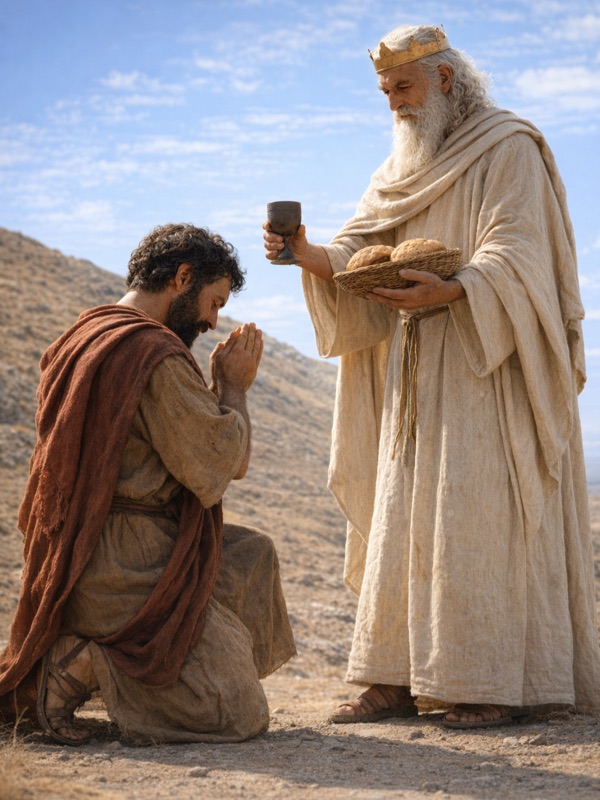
The writer says that Jesus is a priest in the order of Melchisedech. Melchisedech was the mysterious king of Salem who blessed Abraham. His priesthood came before the Law of Moses and is greater than it, so it points to a priesthood that does not pass away.
The New Covenant
The priests of Israel offered the same sacrifices year after year, and the blood of bulls and goats could never take sin away. Once a year the high priest entered the holy of holies, the innermost room of the tabernacle, to offer blood for the people.
Christ did something different. He entered heaven itself, not with the blood of animals but with His own Blood, and He offered Himself once for all. By this one sacrifice He won eternal redemption and made the sinner holy.
The letter recalls the promise of the prophet Jeremias that God would make a new covenant and write His law on the hearts of His people. Christ is the Mediator of this new covenant. The first covenant, the writer says, was growing old and was ready to vanish.
Faith and Endurance
The writer urges the readers to hold fast, for some of them were suffering and some were tempted to turn back. The letter then gives the great teaching on faith: Now faith is the substance of things to be hoped for, the evidence of things that appear not.
Hebrews 11:1
It then lists the faithful of the Old Testament. Abel offered a better sacrifice. Noe built the ark. Abraham set out for a land he did not know and was ready to offer his son Isaac. Moses chose to share the suffering of God's people rather than the pleasures of Egypt. Many others suffered and died without seeing the promise fulfilled.
All of them, the writer says, are a cloud of witnesses around us. We are to run the race with patience, looking to Jesus, the author and finisher of our faith, who endured the Cross and now sits at the right hand of God. The letter also teaches that the Lord corrects those He loves as a father corrects his sons.
Life Under the New Covenant
The last chapter gives plain instructions. The writer asks the readers to love the brethren, to show hospitality to strangers, to honor marriage, and to remember their leaders and those in prison. Christians have an altar of their own, and they offer to God a sacrifice of praise and of good works.
The letter then states the truth on which it rests: Jesus Christ, yesterday, and today; and the same for ever.
Hebrews 13:8 It closes with a blessing and a short greeting.
The central message of Hebrews is that Jesus Christ is the Son of God made man, the one High Priest and the one Sacrifice, in whom everything promised to Israel is fulfilled. The Church sees in this letter a foundation of her teaching on the Mass, where the one offering of Christ on the Cross is made present, and on the heavenly worship that is the hope of all the faithful.
Takeaway
Hebrews leaves you a line worth keeping in your pocket: Jesus Christ is the same yesterday, today and for ever.
Everything else shifts. Work, health, friendships, even our feelings about faith rise and fall.
He does not. And a great cloud of witnesses, who held on before you, surrounds you as you run.
Ask a saint you love to pray for you today, and keep running toward Jesus.