 Crucis
Bible at a Glance · New Testament
Philemon
Letters of Saint Paul · 1 chapter · 3 min read
Scripture quotations from the Douay-Rheims Bible (Challoner revision)
A runaway slave. A Christian master. And Paul in prison, standing between them with a pen.
In a few short lines Philemon shows what grace does to old debts and broken bonds: it turns a slave into a brother.
The Book of Philemon is a short letter from Saint Paul and tells the story of how he asked a Christian master to receive back his runaway slave as a brother in the Lord.
Paul wrote from prison. He addressed the letter to Philemon, in whose house a church gathered, and to the community that met there.
Paul begins with thanks. He has heard of Philemon's faith in the Lord Jesus and of his love for all the saints, and he prays that this sharing of faith may bear fruit.
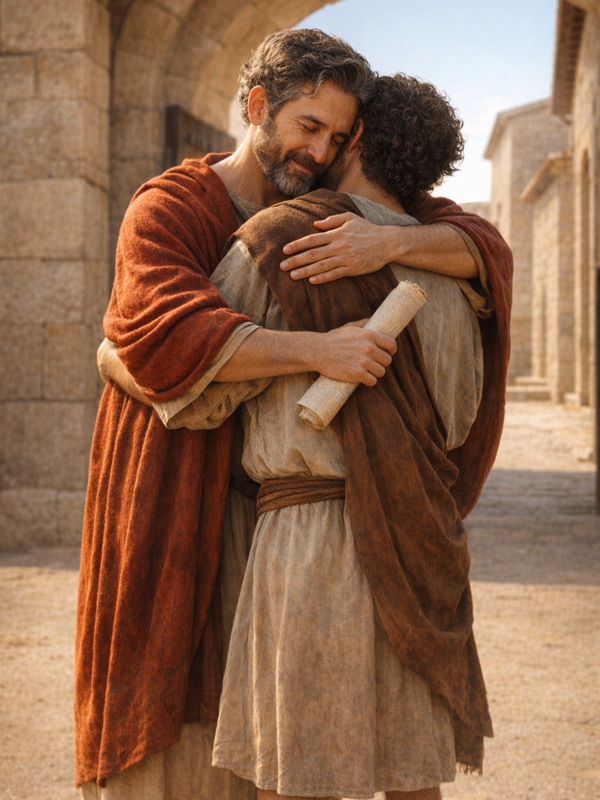
Then Paul comes to his request. Onesimus, a slave of Philemon, had left his master and met Paul in prison. There Paul had become his spiritual father, leading him to Christ.
Paul calls Onesimus my own bowels
Philemon 1:12 and says he would gladly keep him as a help in his chains. Yet he will do nothing without Philemon's consent, so that any good done may be freely given.
Paul sends Onesimus back, and he asks Philemon to receive him not now as a servant, but instead of a servant, a most dear brother
Philemon 1:16. The man who was once useless to his master has become truly useful.
Paul does not command, though he could. He appeals out of love.
Paul also offers to pay whatever Onesimus has wronged or owes. He writes in his own hand that he will repay it.
The letter closes with greetings from Paul's companions, a request to prepare a guest room for his visit, and a blessing of the grace of Christ.
The central message of Philemon is that the grace of Christ makes new bonds among men, so that master and slave become brothers in one Lord. Paul stands between the offender and the offended, ready to bear the debt, and in this he shows the work of Jesus Christ, who reconciles sinners to the Father and makes them one family in His Church.
Takeaway
Whatever Onesimus owes, Paul writes, charge it to me. I will repay.
That is exactly what Christ has done for you. Every debt, every wrong, He took upon Himself.
Someone may owe you an apology, or more. Holding on to the bill feels like justice, yet it keeps you chained as well.
Today, cancel one debt in your heart, and say a Hail Mary for the person who owes it.