 Crucis
Bible at a Glance · Old Testament
Nehemiah
Historical books · 13 chapters · 3 min read
Scripture quotations from the Douay-Rheims Bible (Challoner revision)
Some prayers end with amen. Nehemiah's ended at a building site. Fifty-two days later, Jerusalem had its walls again.
Nehemiah is prayer turned into action, and the story of a people who weep at hearing God's Word and then learn to find their strength in His joy.
The Book of Nehemiah is a historical book of the Old Testament and tells the story of how a cupbearer of the Persian king rebuilt the walls of Jerusalem and led God's people back to faithful life under His law.
Nehemiah's Prayer
Around 587 years before Christ, Babylon destroyed Jerusalem and its walls. Later, around 445 years before Christ, Nehemiah, a Jew who served as cupbearer to King Artaxerxes of Persia, heard that the survivors in Jerusalem lived in trouble and shame, with the walls still broken.
Nehemiah wept, fasted and prayed to the God of heaven. When the king saw his sadness, Nehemiah asked to be sent to rebuild the city, and the king agreed and made him governor of Judah.
Rebuilding the Wall
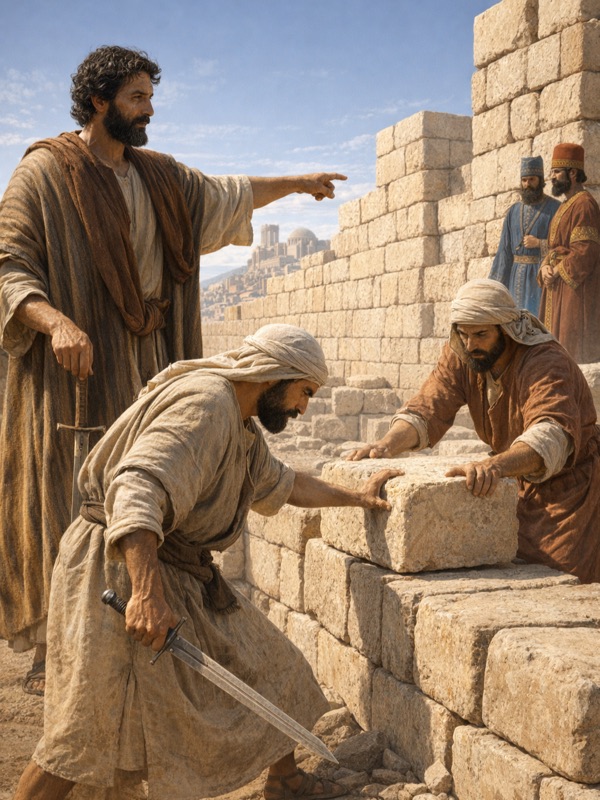
Nehemiah came to Jerusalem and inspected the ruined walls by night. Then he told the people that God's hand had been with him, and they answered: Let us rise up, and build.
Nehemiah 2:18
Families and priests each took a section of the wall. Their enemies, Sanballat and Tobiah, mocked them and then threatened attack. Nehemiah set guards, so that half the men worked while the other half held spears, and he trusted in God.
He also corrected the rich who were oppressing their poor brothers with debts, and made them give back what they had taken. The wall was finished in fifty-two days.
Ezra Reads the Law
The people gathered in the square, and Ezra the priest read the Law of Moses from morning until midday. The Levites explained its meaning, and the people wept when they heard it.
Nehemiah told them not to grieve, for it was a holy day: the joy of the Lord is our strength.
Nehemiah 8:10 They kept the Feast of Tabernacles and lived in booths for seven days.
Renewal of the Covenant
The people confessed their sins, remembered God's mercy through their history, and sealed a covenant to walk in His law, keep the Sabbath and support the Temple. One in ten was chosen by lot to live in Jerusalem, and the wall was dedicated with thanksgiving, songs and processions.
In the thirty-second year of Artaxerxes, Nehemiah went back to the king. When he returned to Jerusalem, he found that the people had slipped: Tobiah was living in a room of the Temple, the Levites had not been paid, the Sabbath was broken, and foreign marriages had led many astray. Nehemiah set these things right and prayed that God would remember him.
The central message of Nehemiah is that God restores His people when they turn to Him, and that a rebuilt city and a renewed heart go together through His Word. The restored Jerusalem prepares the way for Jesus Christ, born of this people, who builds His Church, the new Jerusalem, and gathers a people fed by His Word and strengthened by His joy.
Takeaway
Nehemiah's work did not end with the wall. He came back to find the Sabbath broken, the Levites unpaid and old sins creeping in, and he set things right once more.
Faithfulness is rarely won once. Walls need tending.
If you are tired of beginning again, remember that your strength comes from the Lord's joy, not from your own success.
Pick one habit that has slipped, a morning prayer or a restful Sunday, and rebuild it this week.