 Crucis
Bible at a Glance · Old Testament
Exodus
The Pentateuch · 40 chapters · 6 min read
Scripture quotations from the Douay-Rheims Bible (Challoner revision)
A baby in a basket. A bush that burns and is not consumed. A sea that opens for slaves on the run.
Exodus tells how God heard His people's cry, broke their chains and came to live among them, and its Passover lamb already points to Christ.
The Book of Exodus is the second book of the Bible and tells the story of how God freed His people from slavery in Egypt, made them His own nation at Mount Sinai, and came to live among them.
The Slavery in Egypt
The story begins long after Joseph. The descendants of Jacob, called the Israelites, had grown into a great people in Egypt. A new Pharaoh feared them and made them slaves, forcing them to build his cities.
Still the Israelites multiplied, so Pharaoh ordered that every newborn Hebrew boy be thrown into the river. One mother hid her son for three months and then placed him in a basket among the reeds. Pharaoh's daughter found the child and named him Moses, and he grew up in Pharaoh's house.
The Call of Moses
As a grown man, Moses killed an Egyptian who was beating a Hebrew, and he fled to the land of Midian. There he lived as a shepherd and married Zipporah.
One day on Mount Horeb, Moses saw a bush that burned without being consumed. God spoke from it and sent him to free His people. When Moses asked God's name, He answered: I AM WHO AM.
Exodus 3:14 This name shows that God alone exists by His own power, and that He is always present with His people.
Moses was afraid and said that he spoke poorly. God gave him his brother Aaron to speak with him, and the two went to Pharaoh.
The Ten Plagues
Moses and Aaron asked Pharaoh to let the people go and worship God in the desert. Pharaoh refused and made the slaves work even harder.
Then God struck Egypt with ten plagues. The water turned to blood, and frogs, gnats and flies filled the land. The livestock died, boils broke out, hail and locusts destroyed the crops, and darkness covered Egypt for three days. Each time Pharaoh hardened his heart.
The tenth plague was the death of every firstborn son in Egypt. God commanded each Israelite family to slay a lamb without blemish, mark the doorposts with its blood, and eat the meal in haste with unleavened bread. The Lord passed over the marked houses. This was the first Passover, and Israel was told to keep it as a feast for all generations.
That night Pharaoh finally told the people to go. The Israelites had lived in Egypt about four hundred and thirty years.
The Crossing of the Sea and the Desert
Soon Pharaoh changed his mind and chased them with his chariots. The Israelites were trapped between the army and the sea, and they cried out in fear.
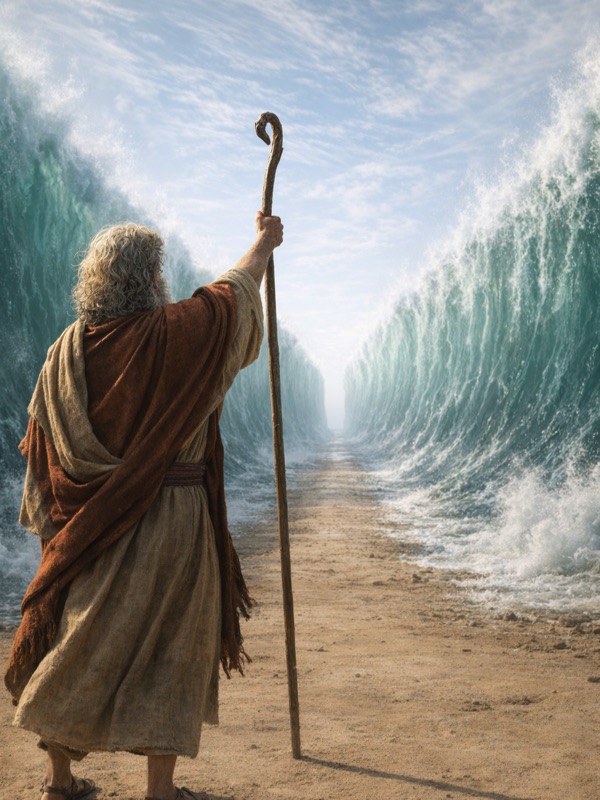
Moses stretched out his hand, and God divided the waters. Israel walked through on dry ground. When the Egyptians followed, the waters returned and drowned them. Moses and the people sang a song of praise to the Lord who had saved them.
In the desert the people grew hungry and thirsty and complained. God gave them bread from heaven called manna each morning, sent quails in the evening, and brought water out of a rock.
The Covenant at Sinai
In the third month after leaving Egypt, the Israelites came to Mount Sinai. There God offered them a covenant, a sacred bond between Himself and them. He said: And you shall be to me a priestly kingdom, and a holy nation.
Exodus 19:6
From the mountain, amid thunder, fire and smoke, God gave the Ten Commandments. The first is: Thou shalt not have strange gods before me.
Exodus 20:3 The commandments were written on two tablets of stone.
God also gave laws for justice, for care of the poor, the widow and the stranger, and for worship. The people promised to do all that the Lord had said, and Moses sealed the covenant with sacrificial blood.
Moses then went up the mountain and stayed forty days and nights. Meanwhile the people grew impatient and had Aaron make a golden calf, which they worshipped. In anger Moses broke the tablets.
Moses pleaded for the people, and God forgave them. He renewed the covenant and wrote the commandments again on new tablets. Moses came down with his face shining from speaking with God.
The Dwelling of God
During the forty days on the mountain, God had given Moses exact plans for a holy tent called the tabernacle, with the ark of the covenant, an altar, and special garments for Aaron and his sons, who were to serve as priests. Now the people gave generously, and skilled craftsmen built everything as commanded.
When the work was finished, a cloud covered the tent, and the glory of the Lord filled it. From then on the cloud guided Israel by day, and fire in it by night, so that God was with them on every step of their journey.
The central message of Exodus is that God hears the cry of the suffering, saves His people by His own power, and binds them to Himself in a covenant of love and law. The Passover lamb and the crossing of the sea foreshadow Jesus Christ, the Lamb of God, who frees us from the slavery of sin through His death and Resurrection and leads us through the waters of Baptism. The manna points to the Eucharist, and the God who dwelt in the tabernacle is revealed fully when the Word became flesh and dwelt among us.
Takeaway
A cloud rests on a tent in the desert. The God who split the sea now camps among His people and goes with them every step of the way.
Freedom did not make the road easy. Israel still grumbled, still feared, and even bowed to a golden calf.
Yet God stayed. He fed them every morning and forgave them when Moses pleaded.
Whatever still holds you captive, name it before Him in prayer today, and trust the One who opened the sea.