 Crucis
Bible at a Glance · Old Testament
Isaiah
The Prophets · 66 chapters · 6 min read
Scripture quotations from the Douay-Rheims Bible (Challoner revision)
A burning coal on a prophet's lips. A virgin with child. A Servant wounded for our sins.
Isaiah moves from judgment to comfort to a new creation, and his promises of Emmanuel and the Suffering Servant find their fulfillment in Jesus Christ.
The Book of Isaiah is the greatest of the prophetic books and tells the story of how God warned His people of judgment, comforted them in their exile, and promised a Saviour who would bring salvation to all nations.
The Call of Isaiah
Isaiah was a prophet in Jerusalem, in the kingdom of Judah. He began his work around seven hundred and forty years before Christ and served under several kings over many years.
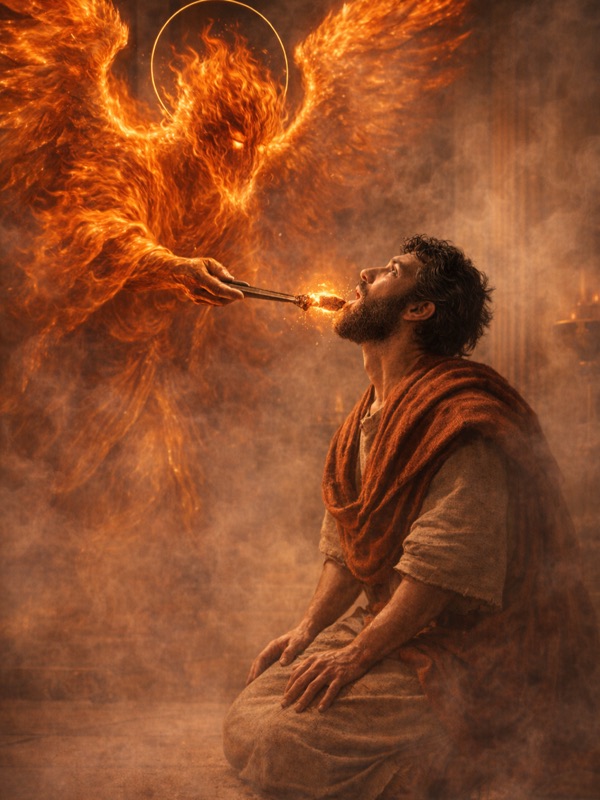
In the year King Uzziah died, Isaiah saw the Lord seated on a high throne in the Temple, and the angels around Him cried out that He is holy. Isaiah feared, for he knew he was a man of unclean lips. An angel touched his mouth with a burning coal, and Isaiah was sent to speak to the people.
Judgment on Judah
The first chapters accuse Judah of great sin. The people offered sacrifices, but they oppressed the poor and ignored the widow and the orphan. Isaiah compares the nation to a vineyard that God planted with care, which gave only wild grapes.
Yet even here God promises a better future. In the last days the mountain of the Lord's house will be raised above all the hills, and all nations will come to it. Isaiah says that God will judge the nations, and they shall turn their swords into ploughshares, and their spears into sickles: nation shall not lift up sword against nation, neither shall they be exercised any more to war.
Isaiah 2:4
The Sign of Emmanuel
Around seven hundred and thirty-five years before Christ, King Ahaz of Judah was threatened by his enemies and put his trust in the power of Assyria instead of God. Isaiah told him to ask for a sign, and Ahaz refused. Then the prophet said: Behold a virgin shall conceive, and bear a son, and his name shall be called Emmanuel.
Isaiah 7:14
The Church has always seen this promise fulfilled in the Virgin Mary and her Son, Jesus, God with us. Isaiah goes on to foretell a child born of the house of David, called Wonderful Counsellor, Mighty God and Prince of Peace. He speaks of a shoot growing from the stump of Jesse, on whom the Spirit of the Lord will rest.
The Nations and the Lord's Day
The next chapters announce God's judgment on Babylon, Moab, Egypt, Tyre and other nations. They show that the Lord is master of all peoples, not only of Israel. The proud will be brought low, and only God will be exalted.
Isaiah then looks beyond the judgment. He describes a feast that the Lord will prepare on His holy mountain for all peoples. On that day God will destroy death forever and wipe away tears from every face.
Hezekiah and Assyria
Around seven hundred and twenty-two years before Christ, Assyria destroyed the northern kingdom of Israel. About twenty years later, King Sennacherib marched against Jerusalem. Hezekiah, the king of Judah, prayed in the Temple, and Isaiah told him that the city would be saved. It was delivered, and the Assyrian army withdrew.
When Hezekiah fell gravely ill, God heard his prayer and added fifteen years to his life. But Hezekiah showed his treasures to envoys from Babylon, and Isaiah warned him that one day Babylon would carry away everything, even the king's own sons.
Comfort for the Exiles
The second part of the book speaks to a later time. Around five hundred and eighty-seven years before Christ, Babylon destroyed Jerusalem and the Temple and carried the people into exile. To these broken people the prophet brings a message of tenderness: Be comforted, be comforted, my people, saith your God.
Isaiah 40:1
A voice cries out in the desert to prepare the way of the Lord. The Gospels teach that this voice was John the Baptist, who came before Jesus. Isaiah declares that the idols of the nations are nothing, and that the Lord alone is God, the Creator of the ends of the earth.
God also names Cyrus, king of Persia, as His instrument. Around five hundred and thirty-nine years before Christ, Cyrus conquered Babylon and allowed the exiles to go home. God shows that He rules the history of every empire.
The Suffering Servant
Through these chapters runs the figure of the Servant of the Lord. He is chosen and gentle, and He brings justice to the nations. He is also rejected, struck and humiliated, though He has done no wrong.
The last of these songs is the most striking. The Servant is led like a lamb to the slaughter and gives His life for others. Isaiah writes: But he was wounded for our iniquities, he was bruised for our sins: the chastisement of our peace was upon him, and by his bruises we are healed.
Isaiah 53:5
The Church sees in these words the Passion of Jesus Christ, who bore our sins and rose in glory.
The New Creation
The final chapters promise the restoration of Zion. Light will rise over Jerusalem, and the nations will come to it, bringing gifts and praising the Lord. A messenger anointed by the Spirit will bring good news to the poor and freedom to captives. Jesus read these very words in the synagogue at Nazareth and said they were fulfilled in Him.
The book ends with the promise of a new heaven and a new earth. God will gather people from every nation, and He will comfort them as a mother comforts her child.
The central message of Isaiah is that God is the Holy One, who judges sin but never abandons His people, and who works out a plan of salvation for all nations. That plan is fulfilled in Jesus Christ, Emmanuel, the Servant who suffered for our sins and whose rising opens the way to a new creation, where death is destroyed and every tear is wiped away.
Takeaway
Isaiah's last image is tender: God comforting His people as a mother comforts her child.
After all the warnings and the ruins, that is where He ends. It may be exactly what you need now, worn down by guilt or by a grief that will not lift.
The Holy One who judges sin is the same God who wipes away every tear. By the Servant's wounds we are healed.
Today, look at a crucifix for one quiet minute, and let Him comfort you.