 Crucis
Bible at a Glance · Old Testament
Jeremiah
The Prophets · 52 chapters · 6 min read
Scripture quotations from the Douay-Rheims Bible (Challoner revision)
Beaten. Put in the stocks. Thrown into a muddy cistern. And still he would not keep silent.
Jeremiah watched Jerusalem fall, yet through him God promised a new covenant written on the heart, sealed by Jesus in His Blood at the Last Supper.
The Book of Jeremiah is a book of prophecy and tells the story of how God sent a young man to warn the people of Judah of coming judgment, to suffer with them through the fall of Jerusalem, and to promise a new covenant that would rise beyond the ruin.
The Call of Jeremiah
Jeremiah was born into a family of priests in the village of Anathoth, close to Jerusalem. God called him around six hundred and twenty-seven years before Christ, in the days of King Josiah, while he was still very young.
God told him that his mission began long before his birth: Before I formed thee in the bowels of thy mother, I knew thee: and before thou camest forth out of the womb, I sanctified thee, and made thee a prophet unto the nations.
Jeremiah 1:5
Jeremiah answered that he was only a child and did not know how to speak. God touched his mouth, placed His own words there, and promised to be with him. Then He showed him a branch of an almond tree and a boiling pot tilted from the north, signs that disaster was coming and that God was watching over His word.
Warnings to Judah
For many years Jeremiah spoke to a people who had turned from God to idols. God said they had forsaken Him, the fountain of living water, and dug for themselves broken cisterns that could hold no water.
Standing at the gate of the Temple, Jeremiah told the people not to trust in the Temple as if it were a charm. If they did not change their ways, God would make Jerusalem as desolate as the ruined shrine at Shiloh.
God also taught him through signs. At the house of a potter he saw clay spoiled and shaped again, and he learned that God could remake a nation that turned back to Him. Then he broke a clay jar before the elders to show how Jerusalem would be shattered.
His faithfulness cost him dearly. The priest Pashhur had him beaten and put in the stocks, and the people plotted against his life, even the men of his own village. Jeremiah cried out to God in bitter honesty, yet he could not keep silent, for God's word burned within him like a fire.
Under King Joakim, Jeremiah dictated all his warnings to his faithful secretary Baruch. When the scroll was read to the king, Joakim cut it up and threw it into the fire. God commanded Jeremiah to write it all again.
The Fall of Jerusalem
Babylon was now the great power of the world. Jeremiah taught that God was using Babylon to punish His people, and that submitting to it was the way to save lives. For this the leaders called him a traitor.
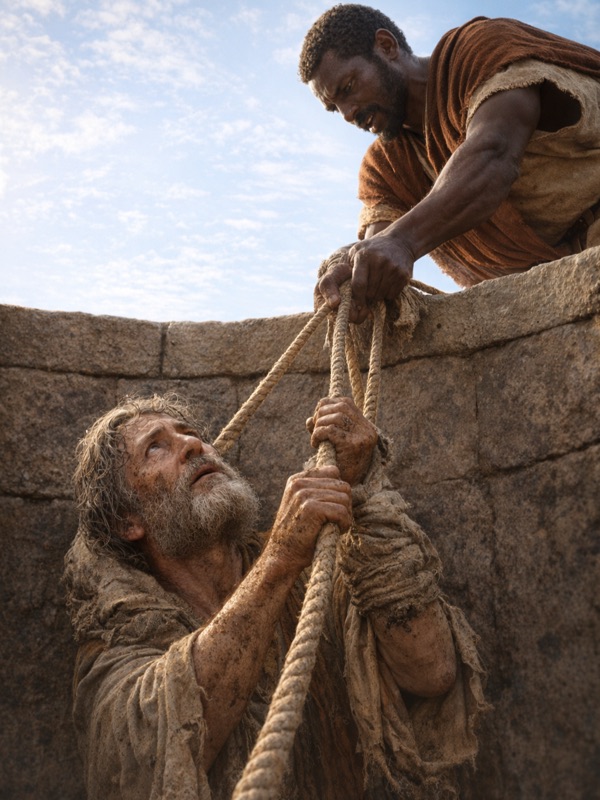
Under the last king, Zedekiah, Babylon besieged Jerusalem. Jeremiah was arrested and thrown into a muddy cistern to die, until a foreign servant of the palace named Ebed-melech pleaded for him and pulled him out with ropes.
Around five hundred and eighty-seven years before Christ, the walls were broken, the Temple was burned, and the people were carried off to Babylon. What Jeremiah had spoken for so many years had come to pass.
Hope and the New Covenant
Even before the final fall, Jeremiah wrote to those already in exile. He told them to build houses, plant gardens and pray for the city where they lived, for their captivity would last seventy years.
God promised through him: For I know the thoughts that I think towards you, saith the Lord, thoughts of peace, and not of affliction, to give you an end and patience.
Jeremiah 29:11
In the chapters often called the Book of Consolation, Jeremiah announces the greatest promise of the book. Behold the days shall come, saith the Lord, and I will make a new covenant with the house of Israel, and with the house of Juda.
Jeremiah 31:31
This covenant would not be written on stone. God said: I will give my law in their bowels, and I will write it in their heart; and I will be their God, and they shall be my people.
Jeremiah 31:33
While Jerusalem lay under siege, God also told Jeremiah to buy a field in Anathoth. The purchase was a sign that houses and fields would again be bought in the land.
The Last Years
After the fall, Babylon appointed Gedaliah governor over those left in Judah, but he was murdered. Fearing revenge, the survivors fled to Egypt and carried Jeremiah and Baruch with them against his will.
In Egypt Jeremiah still warned the people against worshipping idols. The book also contains his words against many foreign nations, especially Babylon, which would one day fall under God's judgment as well.
The book ends in Babylon, where the exiled king Jehoiachin was released from prison and given a place at the royal table, a small sign that God had not forgotten David's line.
The central message of Jeremiah is that God is just and punishes sin, yet He never abandons His people and always prepares a way of mercy. Jeremiah himself, rejected, beaten and condemned by his own people while speaking God's word, foreshadows Christ. The new covenant written on the heart was fulfilled in Jesus, who at the Last Supper gave His Blood as the blood of the new covenant, and who pours out the Holy Spirit so that God's law may live within His people.
Takeaway
Jeremiah ends in Babylon, where an exiled king is brought out of prison and given a seat at the royal table. A small sign, but a real one.
When life collapses, hope can shrink to almost nothing. Jeremiah knew that, and he poured out his bitterness to God.
God's thoughts toward His people are thoughts of peace. He does not abandon them, even in exile.
Watch today for one small sign of His care, and when you find it, stop and thank Him.