 Crucis
Bible at a Glance · Old Testament
Job
Wisdom books · 42 chapters · 5 min read
Scripture quotations from the Douay-Rheims Bible (Challoner revision)
In a single day, everything gone. Seven days of silence. Then a voice from the whirlwind.
Job asks the question every sufferer asks, and receives not an explanation but God Himself, with a faith that points ahead to Christ, the innocent One who suffered for us.
The Book of Job is a work of wisdom and poetry and tells the story of how a righteous man lost everything, struggled to understand his suffering, and was brought to trust God in the darkness.
A Blameless Man
The book begins in the land of Hus, where there lived a man named Job. He was simple and upright, he feared God, and he turned away from evil. He had seven sons and three daughters, great wealth, and the highest name among all the people of the East.
Job was so careful in his devotion that he offered sacrifices for his children after their feasts, in case they had sinned in their hearts.
The Test
The scene then turned to heaven. Satan told God that Job served Him only because he had been blessed. God allowed Satan to test Job, but only within the limits that He set.
In a single day Job lost his oxen, his donkeys, his sheep, his camels and his servants, and then all ten of his children, when a house fell upon them. Job tore his robe, shaved his head, fell to the ground and worshipped. He said: Naked came I out of my mother's womb, and naked shall I return thither: the Lord gave, and the Lord hath taken away: as it hath pleased the Lord so is it done: blessed be the name of the Lord.
Job 1:21
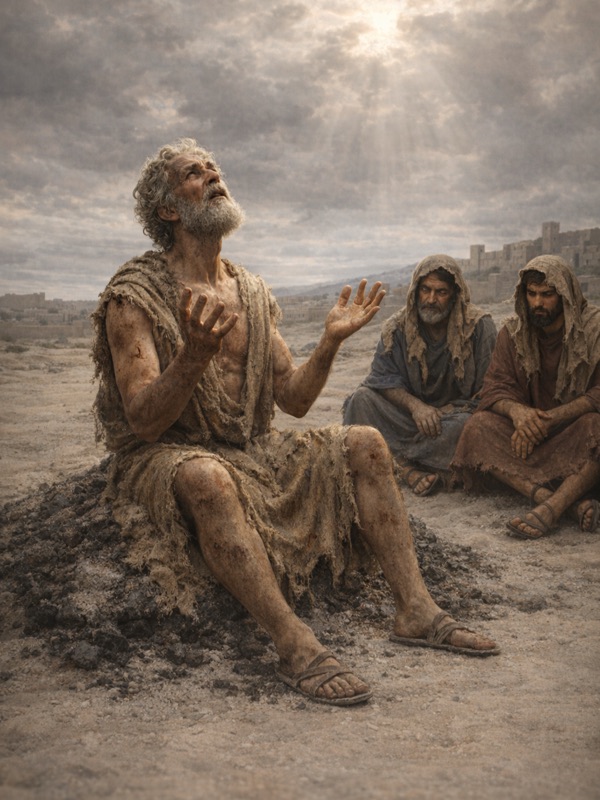
Satan then received leave to strike Job's own body. Job was covered with painful sores from head to foot and sat down among the ashes. His wife told him to curse God and die, but Job refused, and in all this he did not sin with his lips.
The Three Friends
Three friends, Eliphaz, Bildad and Zophar, came to comfort him. When they saw how greatly he suffered, they sat with him on the ground for seven days and seven nights, and none of them spoke a word.
At last Job broke the silence. In bitter and moving poetry he cursed the day he was born and asked why life is given to those who are in misery.
The friends then began to argue with him. They held that God is just, and that therefore suffering must always be the punishment of sin. They told Job to search his conscience and repent.
Job would not accept this. He knew that he was innocent, and he cried out that he wished to bring his case before God Himself. Yet even in his anguish, his faith did not die. He said: For I know that my Redeemer liveth, and in the last day I shall rise out of the earth.
Job 19:25
Elihu Speaks
A younger man named Elihu, who had listened in silence, now spoke. He said that God is greater than any man, and that He may use suffering to teach and to warn the proud. His words prepare the way for the answer that follows.
God Answers
Then the Lord spoke to Job out of a whirlwind. He did not explain why Job had suffered. Instead He asked him where he had been when God laid the foundations of the earth, shut up the sea behind its doors, and set the stars in their places.
God spoke of the wonders of creation, of the lion and the raven, the wild donkey and the horse, and of the great beasts that no man can tame. His questions showed that the wisdom and the power of the Creator are far beyond human understanding.
Job answered that he was small and had spoken of things too great for him. He laid his hand upon his mouth. He had come to know God more truly, not by an explanation, but by meeting Him.
The Restoration
The Lord then turned to the three friends and told them that they had not spoken rightly of Him, as His servant Job had. He commanded them to offer sacrifice, and He said that Job would pray for them.
Job prayed for his friends, and the Lord restored all that he had lost, and gave him twice as much as before. Job received seven sons and three daughters again, and the book tells that his daughters were the fairest women in all the land.
After this Job lived a hundred and forty years. He saw his children and his children's children to the fourth generation, and he died old and full of days.
The central message of Job is that the suffering of the innocent is a mystery which human reason cannot fully solve, and that God is always wise, good and near, even when He is silent. Job's faith, which clings to God without understanding, points toward Jesus Christ, the truly innocent One, who suffered and died for us and rose again. In Him Job's hope of a living Redeemer is fulfilled, and every sorrow is joined to a love that is stronger than death.
Takeaway
Job dies old and full of days, yet the book never tells him why he suffered. God gave him Himself, not an answer.
You may carry a why of your own: an illness, a loss, a prayer that seems to go unheard.
God is not afraid of honest questions. He is near even when He is silent, and in Christ He has entered our suffering from within.
Today, tell Him plainly what hurts. Then pray for someone who has hurt you, as Job prayed for his friends.