 Crucis
Bible at a Glance · Old Testament
Psalms
Wisdom books · 150 chapters · 6 min read
Scripture quotations from the Douay-Rheims Bible (Challoner revision)
Joy. Fear. Guilt. Grief. There is a Psalm for each of them.
These hundred and fifty songs are the prayers Jesus prayed, even on the cross, and the Church still prays them every day, so that no one ever has to come before God without words.
The Book of Psalms is the prayer book of Israel and of the Church, and it teaches how the people of God speak to Him in every hour of life.
The Shape of the Book
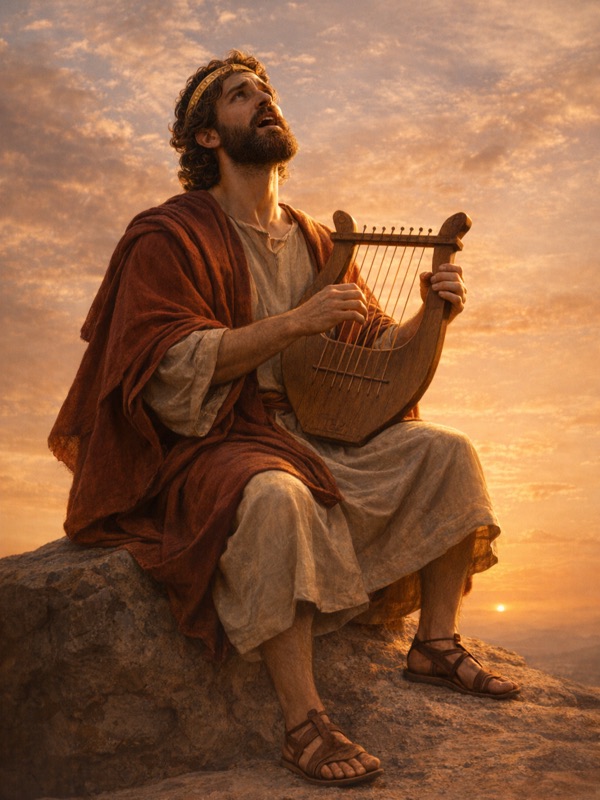
The Psalms are one hundred and fifty songs, gathered over many centuries. Many are linked to King David, who lived about one thousand years before Christ and who was a shepherd, a warrior, a king and a sinner.
The Jewish people divided the book into five parts, as the Law of Moses has five books. The Psalms were sung in the Temple at Jerusalem, and they were prayed by families and pilgrims on the road.
Each Psalm is a poem. Its lines come in pairs, where the second line repeats, deepens or answers the first, and this gives the Psalms a steady rhythm that makes them easy to sing and to remember.
Catholics number the Psalms in the way of the Greek and Latin Bibles, and this summary follows that numbering, so some Psalms are one number behind the Hebrew count.
Songs of Trust
The book opens with two ways. The first Psalm says, Blessed is the man who hath not walked in the counsel of the ungodly
Psalms 1:1, and it compares the just man to a tree planted by running waters, while the wicked are like dust blown by the wind.
Many Psalms are songs of trust. In the best loved of them, David speaks as a shepherd who knows how a shepherd cares for his flock: The Lord ruleth me: and I shall want nothing
Psalms 22:1. Even in the valley of the shadow of death, he says, God is with him.
Other songs of trust say that God is a rock, a fortress and a refuge, and that those who hope in Him will not be put to shame.
Songs of Sorrow
Many other Psalms are cries of pain. The singer is sick, hunted, betrayed or far from home, and he pours out his complaint before God without hiding anything.
Others are prayers of a whole people. After Babylon destroyed Jerusalem, around five hundred and eighty-seven years before Christ, the exiles sat by the rivers of Babylon and wept for Zion, and a Psalm keeps that grief. Yet many of these songs turn at last toward hope in God's mercy.
One Psalm begins in the dark: Out of the depths I have cried to thee, O Lord
Psalms 129:1. It goes on to say that with God there is mercy and plentiful redemption.
Songs of Repentance
Seven Psalms have long been called the penitential Psalms. The most famous is the fiftieth, which tradition ties to David after his sin with Bathsheba and against her husband Uriah, when the prophet Nathan came to him.
David does not excuse himself. He asks, Create a clean heart in me, O God: and renew a right spirit within my bowels
Psalms 50:12. The Church prays this Psalm often, because it shows that God forgives the sinner who returns to Him humbly.
Songs of Praise
Praise runs through the whole book, and the Hebrew name of the collection means praises. The Psalms call on the heavens, the sun and moon, the sea and the mountains to give glory to the Creator.
Some Psalms recall the great works of God: the creation of the world, the call of Abraham, the freedom from Egypt, the crossing of the sea, the forty years in the desert and the gift of the land. By singing these things, Israel remembered that its God had acted in history and would not forsake His people.
Others are songs for pilgrims climbing to Jerusalem for the feasts, and songs for the Temple, which Israel loved as the house of God on earth.
The book ends with a burst of joy. The last Psalm calls on everything that has breath, with trumpet, harp, drum and cymbals, to praise the Lord.
Songs of the King
A special group of Psalms speaks of the king of David's line, the anointed one, whom God chose to rule His people. They describe a ruler who is just, who defends the poor, and whose kingdom will reach the ends of the earth.
Over time Israel saw that these words reached beyond any earthly king. They pointed to the Messiah, the Son of David who was still to come.
One Psalm says, The Lord said to my Lord: Sit thou at my right hand: until I make thy enemies thy footstool
Psalms 109:1. Jesus Himself used these words to show that the Messiah is both David's son and David's Lord.
The Psalms and Christ
The New Testament quotes the Psalms more than any other book of the Old Testament. Jesus learned to pray them as a son of Israel, the hymn He sang with His disciples after the Last Supper was most likely taken from them, and He said that all that was written about Him in the Psalms had to be fulfilled.
On the cross He took up the words of the twenty-first Psalm: O God, my God, look upon me: why hast thou forsaken me?
Psalms 21:2. That Psalm begins in anguish and ends in the triumph of God, and it describes the suffering of the just man in ways the Gospels see fulfilled in the Passion.
From the first Christians until today, the Psalms have been the core of the Church's daily prayer. Monks, priests and lay people pray them in the Liturgy of the Hours, and they are sung at Mass between the readings.
The central message of the Psalms is that God hears His people and that every human feeling, whether joy, fear, guilt or grief, can become prayer before Him. In Christ, the Son of David, the Psalms find their fulfilment, for He prays them as true man, He is the king and shepherd they promised, and He gathers the Church to pray in His voice to the Father.
Takeaway
The Psalms end in a great burst of joy, as everything that has breath is called to praise the Lord.
But the road there runs through the depths. Some days you cannot find words to pray, and the ones you find come out angry, tired or ashamed.
The Psalms show that God wants all of it. No feeling is too dark to bring to Him, and Christ prays with you.
Pick up the shepherd Psalm today and pray it slowly, letting it speak for you.